
Historiallisen miekkailun alkeiskurssi: what happens on your first session
Walking into your first historical fencing class is a strange mix of excitement and nerves. You have probably watched a few longsword videos online, maybe read about German treatises, and now you are standing in a training hall in Jyv?skyl? wondering whether you will be the only person who has never held a sword. You will not be. Everyone in the room started exactly where you are now, and our beginner course — the alkeiskurssi — is built for people with zero prior experience. Here is a honest walkthrough of what your first session actually looks like.
Before You Arrive: What to Expect and How to Prepare
Your first session is a taster within our beginner course, and it is deliberately low-pressure. You do not need to own any equipment, you do not need to know the difference between a feder and a waster, and you do not need to be particularly fit. You need to show up, pay attention, and be willing to move.
What to wear and bring
Comfortable sportswear is the right choice: training trousers or leggings you can lunge in, and a t-shirt you do not mind sweating through. Bring indoor training shoes — we train on a gym floor and outdoor shoes are not allowed on the mats. Pack a water bottle, and if you have long hair, tie it back. A small towel is useful too.
That is genuinely it. All fencing equipment, including synthetic swords and wooden wasters, is provided by the club for beginners. If you own a groin guard or a mouthguard, bring them, but they are not mandatory for the first session.
Arriving at the training hall in Jyv?skyl?
Arrive about 15 minutes early. That gives you time to sign in, change, fill in a short health and emergency contact form, and meet the instructors without feeling rushed. Jyv?skyl? is a city in central Finland known for its active martial arts community, and our hall sits within that network — you will likely meet people who also train in judo, HEMA, or archery elsewhere in town. Introduce yourself to whoever is at the door; they will point you towards the changing rooms and the sign-in sheet.
The Warm-Up and Introduction to Historical Fencing
Every session starts with a group warm-up, and yes, everyone does it — instructors included. This is not a formality. Fencing loads your legs, hips, shoulders, and wrists in ways that everyday life does not, and cold muscles tear.
Dynamic warm-up and footwork basics
We run through dynamic stretches: leg swings, hip openers, shoulder rotations, walking lunges, and light skipping. Then we move into footwork drills — the foundation of everything else. You will learn the basic stance, how to step forward and backward while keeping your guard, and how to pass-step and lunge without losing balance. Expect to feel slightly uncoordinated. That is normal and it passes faster than you think.
A short history of European martial arts
After the warm-up, an instructor gives a short talk on where historical fencing comes from. We cover the German longsword tradition (Liechtenauer and the later masters), the Italian rapier schools (Capoferro, Giganti), and how these systems survived in manuscripts that modern practitioners have reconstructed. We also explain our club’s priorities: safety first, respect for training partners, and technical accuracy over theatrical flair. This is a martial art, not a stage combat class, though many of our members do both.
Your First Taste of Sword Handling and Drills
Now the fun part. Beginners are paired up and handed synthetic swords or wooden wasters. These are not toys — they are weighted and shaped to mimic the real thing closely enough to teach correct mechanics, and they are commonly used for beginner training in the UK and Finland alike because they are safe, durable, and affordable.
Gripping the sword and basic stances
You will learn how to grip a longsword correctly (both hands, dominant hand near the crossguard), how to hold a guard stance without tensing your shoulders, and where your point should be pointing. Small details matter: elbow position, weight distribution, where your eyes are looking. Instructors will come round and adjust your posture individually.
Partner drills: cuts, thrusts, and parries
You then work through slow, controlled drills with your partner. Typical first-session material includes:
- Basic cuts — the Oberhau (descending cut) and Unterhau (rising cut)
- Simple thrusts from the guard
- Corresponding parries against each of those attacks
- Stepping in and out of measure while maintaining your guard
The instruction you will hear repeatedly is ”slow down”. Control beats speed every time at this stage. A slow, accurate cut teaches your body the correct path; a fast, sloppy one teaches bad habits that take months to undo.
Safety, Etiquette, and the Role of Gear
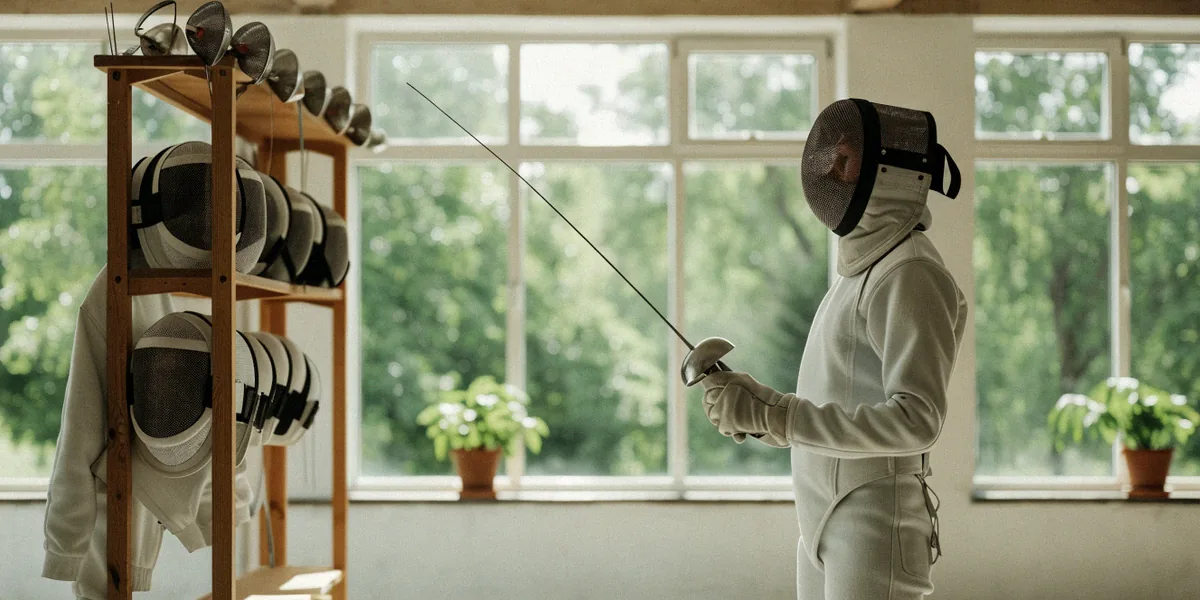
Safety rules are explained before any contact happens, and they are not negotiable. There is no free sparring on day one — none. Beginners drill only, at controlled speed, with agreed techniques. Any contact drill requires a fencing mask and gloves as a minimum.
Essential safety equipment
For the first session you will borrow a mask and gloves from the club. As you progress into the full alkeiskurssi, you will be expected to acquire your own:
- Fencing mask (1600N rated for steel, lighter for synthetics)
- Padded gloves or lacrosse gloves
- Groin guard
- Knee and elbow pads
- Eventually, a padded jacket (gambeson) for steel training
Our safety and training standards follow guidelines similar to those set by the British Federation for Historical Swordplay (BFHS), which is widely referenced by UK clubs and provides a sensible baseline for protective equipment and sparring conduct. If you have trained at a UK club before, the approach here will feel familiar.
Club etiquette and mutual respect
We bow to the salle when entering and leaving, and we salute our training partner before and after each drill. We acknowledge every hit, whether it landed cleanly or not. We do not argue about points during training. This etiquette is not ceremonial stiffness — it is what allows people to train hard together safely and come back the following week. Many UK practitioners also visit the Royal Armouries in Leeds, which hosts historical fencing events and serves as a key resource for the wider community; that same spirit of shared respect runs through clubs like ours.
After the Session: Next Steps and How to Join
The last 10 minutes are for cooling down and questions. Do not skip the questions.
Cool-down and feedback
We finish with gentle stretches and a short debrief. Instructors will ask how it felt, what confused you, and whether anything hurt in a bad way. This is your chance to ask about anything — grip, footwork, terminology, gear recommendations, whatever. We would rather answer ten questions than have you leave unsure.
Signing up for the full course
If you enjoyed the session, the next step is signing up for the full alkeiskurssi, which runs over several weeks and covers longsword fundamentals in proper depth. You will get the course dates, membership fees, and payment details at the end of the session or by email afterwards. Beyond the beginner course, the club also offers ratsumiekkailu (mounted fencing) and vaistojousiammunta (instinctive archery) — both are open to members once you have some basic training behind you.
FAQ
Do I need any previous martial arts or fencing experience?
No. The alkeiskurssi assumes you have never held a sword. Most people who start with us have no martial arts background at all. If you have done sport fencing, judo, or any other discipline, it may help slightly with footwork, but it is not required.
Is historical fencing safe?
Yes, when trained properly. Beginners do controlled drills only, with masks and gloves, and no free sparring on day one. Our safety standards follow guidelines similar to those of the British Federation for Historical Swordplay (BFHS), which UK clubs also use.
What equipment do I need for the first session?
Just sportswear, indoor shoes, and water. We provide synthetic swords, wooden wasters, masks, and gloves for beginners. You can buy your own gear later once you decide to continue.
How fit do I need to be?
Reasonably mobile is enough. Fencing will improve your fitness quickly, but the first session is paced for people who have not exercised in a while. Tell an instructor about any injuries or limitations before the warm-up.
Can I try ratsumiekkailu or vaistojousiammunta straight away?
Those activities are open to members who have completed the beginner course. Get the longsword fundamentals down first — the footwork and body mechanics carry over directly into mounted fencing and archery.
Your first session is designed to be welcoming, a bit sweaty, and genuinely fun. By the end of it you will have a working guard stance, a couple of cuts, a clear idea of how a drill works, and a straightforward path to keep training with us in Jyv?skyl?. Come as you are — we will handle the rest.