
Vaistojousiammunta: Tarkkuutta Ilman Tähtäimiä
How does an archer hit a target without any sights? No pins, no scope, no mechanical reference point — just a bow, an arrow, and the body’s own sense of direction. That question sits at the heart of vaistojousiammunta, instinctive archery, and it is exactly what we practise at our historical fencing and martial arts club in Jyväskylä, Finland. Whether you come to us from historiallinen miekkailu, ratsumiekkailu, or you have never drawn a bow before, instinctive shooting teaches you to trust your hands, your eyes, and your release.
What Is Vaistojousiammunta?
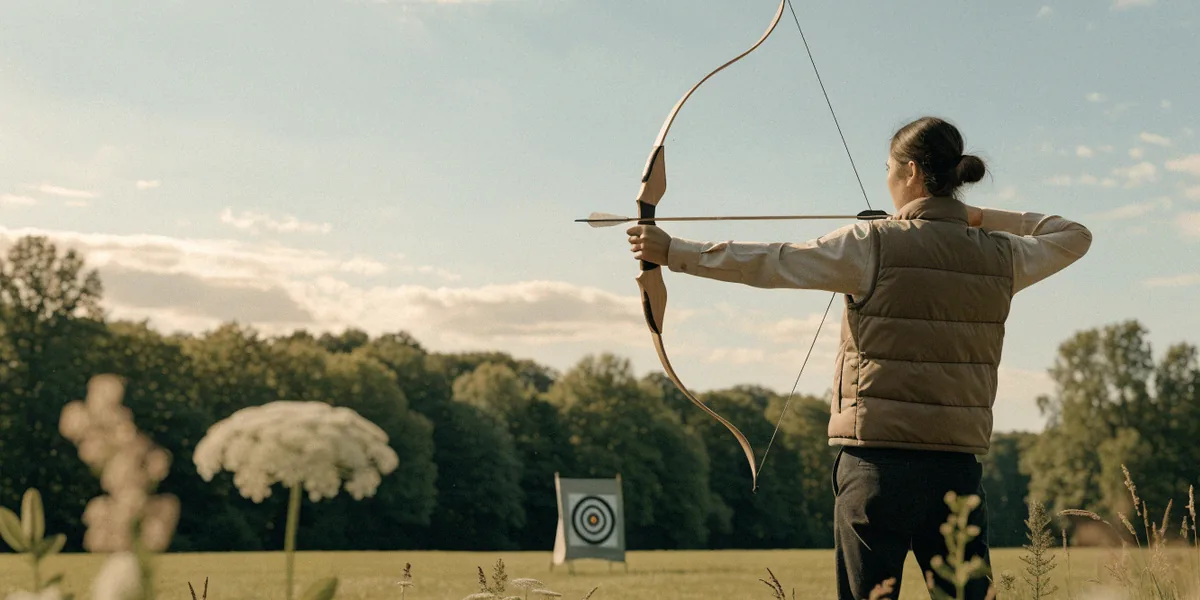
Vaistojousiammunta is instinctive archery: shooting a bow without sights, relying on the body’s natural hand-eye coordination rather than a sighting system. The archer looks at the target, not at the arrow or the bow, and the shot happens as a single, fluid movement. It is the archery of hunters, soldiers, and horsemen across Finnish and European history, and it stands apart from the sighted target archery most people encounter at modern clubs.
Instinctive Shooting vs. Aimed Shooting
Modern target archery is a precision discipline built around reference points. Recurve and compound archers use pins, scopes, clickers, and stabilisers, and they aim deliberately at a fixed distance they have already measured. Instinctive shooting removes all of that. There is no sight to line up, no clicker to tell you when to release, and no reliance on a known yardage. You shoot the same way you would throw a ball: your brain calculates the distance and angle unconsciously, and your body executes the shot.
That does not make instinctive archery random. It is a trained skill, and like any skill it is built through repetition, consistency, and honest feedback. The difference is where the reference lives — in the archer’s body rather than on the bow.
Historical Context of Sightless Archery
Sightless shooting is not a modern invention or a novelty category. Finnish hunting traditions, the archery of mounted steppe peoples, and the English longbow tradition all produced archers who shot without sights because sights did not exist in usable form. A medieval bowman on a battlefield did not measure distance to a target; he drew, loosed, and drew again. The English warbow, in particular, was a weapon of volume and instinct, and the modern revival of that tradition — including the work of the English Warbow Society — keeps sightless shooting alive as a living practice rather than a museum piece.
The Technique: How We Shoot Without Sights
Instinctive archery rests on three pillars: a consistent anchor point, active back tension, and a visual method for judging distance. Get those three right and the arrow goes where you look. Get them inconsistent and no amount of aiming will save the shot.
Anchor Point and Back Tension
The anchor point is where your drawing hand settles against your face at full draw — the corner of the mouth, the jawline, the cheekbone. It must be the same every single time, because your anchor is your rear sight. If the hand moves, the arrow moves. We teach new archers to find their anchor early and to treat it as non-negotiable.
Back tension is the second half of the shot. Rather than pulling the string with the arm and releasing with the fingers, you draw with the large muscles of the back and let the release happen as a consequence of continued tension. The hand relaxes, the string slips, and the arrow leaves cleanly. This is the same principle described by instinctive archery author G. Fred Asbell, whose writing on the subject remains a standard reference for anyone learning to shoot without sights.
The Gap Method and Split Vision
Not every instinctive archer shoots purely by feel. The gap method and split vision are two techniques that bridge the gap between pure instinct and conscious aiming.
- Gap method: you keep your eye on the target but are aware of the arrow tip in your peripheral vision, learning what the gap between tip and target looks like at different distances.
- Split vision: your focus stays on the target while you remain conscious of the bow and arrow in the background, letting the brain combine both images into a single aim.
- Pure instinct: the most advanced form, where neither the arrow nor the bow is consciously referenced — only the target.
Most archers move along this spectrum over time. We start beginners with split vision because it gives them something concrete to work with, then gradually let them drift toward pure instinct as their form stabilises.
Why We Teach Vaistojousiammunta at Our Club
Our club is based in Jyväskylä, in central Finland, and our training covers historiallinen miekkailu, ratsumiekkailu, and traditional archery. Vaistojousiammunta is not a side activity for us — it is a direct complement to everything else we do.
Integration with Historical Fencing and Mounted Combat
Historical fencing teaches timing, distance, and the ability to act without conscious calculation. Instinctive archery trains exactly the same faculties. When you shoot without sights, you are learning to judge distance with your body, to commit to a movement, and to accept the result without hesitation — all of which transfer directly to sword work and to ratsumiekkailu, where a rider must shoot, rein, and balance simultaneously.
Mounted archery is the clearest example. A horsebow archer cannot stop, aim, and check a sight. The shot must happen within the rhythm of the horse’s stride, which is instinctive archery in its purest form. Our ratsumiekkailu training and our archery training feed each other.
Beginner Course (Alkeiskurssi) Pathway
Every new member starts with our alkeiskurssi, the beginner course. It runs as a structured introduction to the club’s disciplines, and archery is one of the first things we teach because it builds focus and body awareness quickly. From the alkeiskurssi you can continue into regular archery sessions, historical fencing, or mounted combat — or all three. No prior experience is required, and no sights are needed to begin.
Equipment for Instinctive Archery
One of the appeals of vaistojousiammunta is how little equipment it demands. A bow, a set of arrows, a glove or tab, and an arm guard will get you shooting. What matters is that the equipment suits the style.
Choosing a Traditional Bow
There are three main bow families used in instinctive archery, and each has its own character:
- Longbow: the English warbow tradition — simple, quiet, and demanding of good form. Historically significant and still shot competitively in the UK.
- Recurve: a traditional recurve without sights is the most common starting bow. Forgiving, widely available, and easy to source in a range of draw weights.
- Horsebow: a short, reflexed bow designed for shooting from horseback. Essential for anyone pursuing ratsumiekkailu and mounted archery.
For UK readers, Merlin Archery is one of the most reliable suppliers of traditional bows, arrows, and accessories, and their range covers everything from entry-level recurves to warbow-weight longbows. We recommend starting with a draw weight you can control comfortably for an entire session — 20 to 30 pounds for most beginners — rather than the heaviest bow you can pull once.
Arrows and Accessories for Sightless Shooting
Arrow selection matters more than most beginners expect. Wooden shafts suit traditional bows and are the historical choice, while carbon and aluminium arrows offer durability for high-volume practice. Fletching, nock fit, and spine must match your bow weight, or the arrow will fly inconsistently no matter how good your form is. Beyond arrows, you need a finger tab or glove, an arm guard, and a bowstringer. You do not need a sight, a clicker, or a stabiliser — and we actively discourage them for instinctive shooting.
Training Drills and Progression
Instinctive archery improves through deliberate, repetitive practice. We use a small set of drills that build form before distance, and we borrow structure from organisations such as the UK’s National Field Archery Society (NFAS), whose field courses and scoring systems give archers clear progression targets.
Blank Bale and Close-Range Drills
Blank bale practice is the foundation. You stand a few metres from a bare target butt with no target face at all, and you shoot purely for form: anchor, back tension, clean release. With no target to hit, there is nothing to aim at and nothing to blame — only your own consistency. We recommend starting every session with ten to twenty blank bale shots before moving to a target.
From there we move to close-range work at five to ten metres, where the arrow’s flight is short enough to give immediate feedback on release quality.
Scoring and Distance Progression
Once form is stable, we introduce the 10-10-10 routine: ten arrows at a short distance, ten at a medium distance, ten at a long distance, scored honestly. The purpose is not to chase a high score but to see where your consistency breaks down. Most archers find their groups open up at a specific distance, which tells them exactly what to work on next. Over weeks and months, the distances move back and the groups tighten.
Getting Started in the UK and Finland
Opportunities to learn instinctive archery exist in both countries, and the pathways look different in each.
Finding a Club in the UK
The UK has a deep traditional archery culture. The National Field Archery Society (NFAS) is the largest body for field and instinctive archery, with affiliated clubs across the country running unmarked and marked field courses where sights are often not permitted at all. The English Warbow Society caters to those drawn to the heavy longbow tradition and historical shooting. Merlin Archery supplies the equipment, and most NFAS clubs welcome beginners with loan kit available.
Our Beginner Course in Jyväskylä
In Finland, our club in Jyväskylä runs its own alkeiskurssi for anyone wanting to start. The course covers safety, basic form, instinctive shooting technique, and an introduction to the club’s wider disciplines — historiallinen miekkailu, ratsumiekkailu, and vaistojousiammunta. Equipment is provided for beginners, so you can try instinctive archery before committing to a bow of your own. Sessions are held in Jyväskylä and are open to adults of all fitness levels.
Usein Kysytyt Kysymykset
Do I need any previous archery experience to start?
No. Our alkeiskurssi assumes no prior experience at all. We start with safety, basic form, and close-range shooting, and we provide loan equipment so you can learn before buying anything.
Can I shoot instinctively with a modern recurve bow?
Yes. Any traditional recurve without a sight can be shot instinctively. What matters is that you remove the sighting equipment and commit to the technique rather than the bow’s category.
How long does it take to become accurate without sights?
Most archers see meaningful improvement within a few months of regular practice, but instinctive accuracy is a long-term skill. Consistency in anchor point and release matters far more than raw talent.
Is instinctive archery suitable for mounted combat training?
It is essential for it. Shooting from horseback leaves no opportunity to aim mechanically, so ratsumiekkailu students at our club train instinctive archery as a core skill alongside riding.
Where can I buy traditional archery equipment in the UK?
Merlin Archery is a well-established UK supplier of traditional bows, arrows, and accessories. For longbow-specific gear and historical context, the English Warbow Society is also a useful reference.
Vaistojousiammunta is a skill anyone can learn with patience and consistent practice. It asks for no sights, no gadgets, and no prior experience — only a willingness to draw, release, and adjust. If you are in central Finland, join our alkeiskurssi in Jyväskylä and start shooting the way archers did for centuries. If you are in the UK, look up your local NFAS club or the English Warbow Society, pick up a traditional bow from a supplier like Merlin Archery, and begin. The target is out there. Your body already knows how to find it.